







Health 6 Posture Fixes That Restore Energy and Alignment
We often think that real health comes from big, heroic efforts – like exercising intensely, improving your diet over the weekend, or finally going to that long-awaited doctor’s appointment. But what if the most impactful thing you can do for your health isn’t a big move? What if this already happened – right now – while you’re hunched over your desk, thumbing away at your phone, or gripping the steering wheel as you travel?
The quiet, consistent habit is your attitude. It’s not just about ‘standing out’ for show – it’s a silent conversation between the body and the nervous system. Every time you slouch, bend your neck forward, or turn your shoulders, you send signals that say “I’m tired”, “I’m stressed”, or “I’m closed”. And over time, your body begins to trust them. That low rumble of fatigue, the lingering tension between your shoulder blades, the mid-afternoon energy crash? Much of this can be traced back to how you handle yourself – without even realizing it.
The good news is that your body loves a second chance. You don’t have to move around like there’s a book over your head or lock your spine in a rigid military stance. You stop wasting energy just standing still – and start to feel more present, grounded, and alive.
And the best part? You don’t have to change your whole life to get there. With just a few small, mindful changes—how you sit in your chair, how you stand while waiting in line, how you move from one task to the next—you can start collecting “mail.”
Table of Contents
Fix #1: Find Your “Ear Over Shoulder”
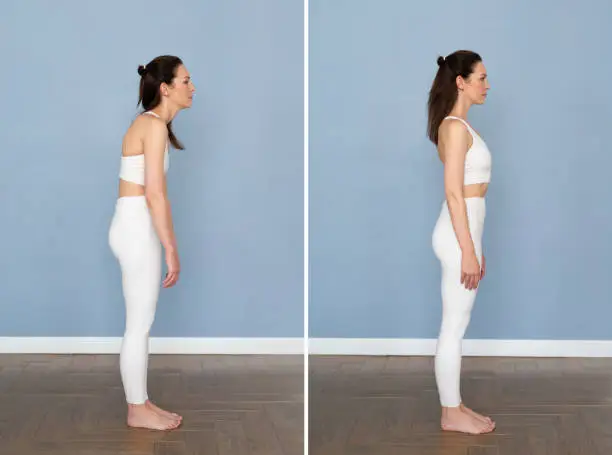
Good posture doesn’t mean shrugging your shoulders or pretending to pose for a photo—it’s about returning to the calm, natural balance your body already knows. When you’re standing or sitting in a way that feels really comfortable, your ears, shoulders, and hips should line up side by side in a soft, comfortable column.
It’s not about forcing yourself to adopt the “perfect” posture; It’s about giving your body space to settle into the alignment it was designed for – where strength and lightness coexist.
But let’s be honest: our daily routines work against that balance. Spending hours hunched over a keyboard, eyes glued to the phone or shoulders hunched around the steering wheel has trained us to live with our heads tilted forward – often without realising it.
And that seemingly small shift carries an enormous burden. For every inch your head moves forward, there is about 10 extra pounds of stress on your neck and upper back. So if your head is turned just three centimetres forward – which is a very common position these days – it’s as if your muscles are lifting 42 kilograms all day. Imagine carrying a preschooler on your shoulders from morning to night…and never putting them down.
Beautiful things? You can press the light reset button at any time. This is called a chin tuck and takes less than 10 seconds. Sit or stand comfortably, look straight ahead and slowly push your head straight back – as if doing a subtle double chin.
Keep your eyes level; Don’t look down. You will feel a slight stretch at the base of your skull and slight activation in the front of your neck. Hold for a few breaths, then release. Repeat this 5 to 10 times, a few times a day – during a Zoom call, while the coffee is brewing, or while waiting for the microwave. There is no need for anyone to notice.
Fix #2: Un-glue Your Shoulders from Your Ears
If you’ve ever found yourself over your shoulders and practically brushing your ears—perhaps while racing to meet a deadline, sitting in traffic, or even just scrolling on your phone—you’re not alone. Many of us walk with our shoulders up as if we are preparing for something, carrying the weight of the day on our shoulders and we don’t even realize it. It’s as if our bodies are stuck in silent “prepare for anything” mode, even when there’s nothing to prepare for.
This health habit does more than just make you look stressed—it actually keeps your body in a state of low stress. When your shoulders remain elevated, the large muscles in your upper back and neck (your traps) are locked in constant tension. Over time, this leads to those stubborn lumps, stiffness, and even that dull, nagging headache that won’t go away. What’s worse, it compresses your neck and restricts healthy blood flow, meaning less oxygen and nutrients reach your muscles and brain, draining your vitality without you even realising it.
Good news? You can gently return your shoulders to their resting position with a simple, soothing movement: shoulder rotation and reset. Do you feel a light pressure between your shoulder blades? This is your body breathing a sigh of relief. Do this 5 to 10 times, and make it a habit to “check in” with your shoulders a few times a day – at your desk, in the car, even while brushing your teeth.
This little ritual does more than just ease congestion—it opens up your breathing. As the shoulders drop, the chest opens, allowing the diaphragm room to move and get oxygen.
Fix #3: Stop Sitting Like a Pretzel
We are all huddled inward around a screen like a hearth in a storm—knees bent, spine bent, shoulders hunched like armour against the world. For the moment, it feels safe, even comfortable. But then an hour later you emerge with a lump in your neck, a slight ache in your lower back and the heavy, hazy tiredness that sleep alone can’t fix.
The “comfortable” recession? It silently compresses your lungs, compresses your organs, and wreaks havoc on the gentle, supportive curves of your spine that are necessary to keep you strong and pain-free.
Place both feet flat on the floor, hip-width apart, like a tree sending its roots down into the earth. This stabilises the pelvis, preventing the domino effect of misalignment moving through the spine and settling as tension in the neck and jaw.
And if the back of the chair feels flat or hollow, place a rolled-up towel or small pillow behind the lower back. This isn’t indulgence—it’s a silent act of respect for your body, whispering: You’re not meant to turn inward. You are made to stand, sit and breathe with ease.
When you sit like this, something changes inside you – not just physically, but energetically. Your core works without strain, your breathing naturally deepens, and oxygen flows more freely to your brain and muscles. The deep, spontaneous breath becomes a source of peace and clarity – promotes steady focus.
Fix #4: Become a Master of the Hip Hinge
We bend without thinking all day long – to catch the morning coffee mug, to tie a shoelace, to rescue a pen that has fallen from under the sofa. It feels automatic, almost effortless. But the proverbial “twist at the waist” move?
It is putting all the stress on the lower back instead of the muscles. Over time, repeated micro-moments of poor form add up, leading to stiffness, pain, or even injury—not from lifting heavy things, but from habits that seem harmless.
Instead of bending your spine forward, stand straight, keep your back straight and bend your hips back as if you are reaching for a wall behind you. Your chest stays lifted, your spine stays long, and the movement comes from your hips—not your waist. Think of it less as bending and more as bending with intention.
You will probably feel a slight stretch in the back of your thighs – these are the hamstrings moving forward to share the load. And when is it time to get up?
Do not pull yourself straight with your back. Instead, gently squeeze your glutes to push your hips forward. It’s a subtle change, but it transforms bending from a passive, risky movement to an active, empowering movement—as if your body is finally working with you instead of against you.
Do this consistently, and something remarkable happens: Everyday activities become opportunities to build resilience. Your glutes and legs are doing what they were designed to do—lifting the weight—while your back gets the rest it deserves. outcome? Less fatigue, less pain and a calm confidence in the body’s strength and ability to live life with ease – even during the smallest, most common tasks.
Fix #5: Tame the Text Neck
We’ve all felt it – the dull ache at the base of the skull, the stiffness all the way up to the shoulders, the vague tiredness after scrolling, texting or working too long at a screen. What we often brush off as “just a long day” is actually our throat silently crying under the weight of our bowed head.
As soon as you glance at your phone, your head tilts forward every inch, multiplying the stress on your cervical spine, straining muscles, compressing discs, and inviting pain that can last far beyond screen time.
When your neck doesn’t have to fight gravity all day, something incredible happens: Stress disappears, headaches subside, and blood flows more freely to your brain.
That mental fog lifts, your focus sharpens, and you feel more present—not exhausted by your devices, but energised despite them. In a world that constantly tells us to look down, looking up is a small act of self-care with big rewards.
Fix #6: Wake Up Your Glutes
You may not give them much thought, but your glutes are your body’s silent powerhouse—your engine for standing taller, moving with ease, and moving through life without pain. Yet sitting for hours on end – whether at a desk, in the car or on the sofa – can put these muscles into a deep sleep.
When your glutes “check out”, other muscles struggle to pick up the slack: The lower back stiffens, the hamstrings strain and the hip flexors shorten. Over time, this imbalance causes stiffness, fatigue and excruciating lower back pain.
Good news? You can wake them up – gently, effectively and without the need for a gym. Then, gently squeezing your glutes, lift your hips until your body forms a straight line from shoulders to knees. No rush, no stress—just a clean, purposeful lift that reminds your body, “Hey, I’m still here.”
Just hold at the top to breathe, being careful not to strain your lower back or arch too much. Then slowly descend again while maintaining full control.
Just two sets of 10 to 15 repetitions per day can begin to reawaken those dormant muscles and restore balance to your posture. Think of it less as exercise and more as a daily conversation with your body—one that says, “Let’s work together again.”
When your glutes are active and strong, everyday activities become easier and more efficient. Walking feels springier, standing feels more stable, and your spine finally gets the support it’s been missing. You no longer drag yourself throughout the day – your body has a stable, powerful base to draw from. And that?
Making Posture a Habit for Lifelong Health
Asana does not mean standing like a statue or rigidly holding yourself “perfect”. It’s about coming home to the body again and again through small, gentle moments of awareness. Maybe there’s a note on your screen that says “Ears on your shoulders!”
Or the gentle ring from the phone every hour that reminds you to lean back in your chair. These are not jobs; They are gentle prompts, loving invitations to reconnect with how you handle yourself in the world.
Real change happens not in a grand gesture, but in small, repeated choices: rolling your shoulders back after a long conversation, choosing to bend your hips instead of rounding your spine, or simply feeling your feet on the floor as you type. Each of these actions is like making a silent deposit in the body’s “health account” – which grows over time.
You don’t need to make big changes in your life. You just need to present your case consistently and kindly.
Every time you adjust your screen to eye level, squeeze your glutes under a bridge, or get up to stretch after sitting, you’re sending a message: You matter. Your energy matters. What matters is your long-term well-being. This isn’t just self-care – it’s dynamic self-esteem.
And as these micro-habits are incorporated into your daily routine, some beautiful things happen. Your body begins to feel lighter, your breathing becomes deeper, and your movements become easier.
You “fix attitude” – you create a feeling of flexibility, vitality and presence. In a world that often pulls us outward, this inner focus—on alignment, breath, and balance—is one of the most holistic, empowering gifts you can give yourself.
1. How can posture really affect my energy levels?
Poor posture—like slouching or hunching—compresses your lungs and restricts breathing, reducing oxygen flow to your brain and muscles. Correct alignment opens your chest, improves circulation, and helps your core work efficiently, all of which boost natural energy.
2. How long does it take to see benefits from better posture?
Many people feel immediate relief in breathing and comfort after just a few mindful adjustments. With consistent practice—like using the “hip higher than knee” rule or doing daily glute bridges—you can notice lasting improvements in energy, reduced pain, and better focus within a few weeks.
3. Do I need special equipment to improve my posture?
Not at all! Simple, everyday items like a rolled-up towel for lumbar support, a stack of books to raise your laptop, or even a timer to remind you to move can make a big difference. The most powerful tools are awareness and small, consistent habits.